



How to Measure Light for Plants

One of the biggest difficulties we notice among our clients is their ability to assess the proper lighting for their plants. It’s not easy. The human eye automatically compensates for brightness, which makes our ability to judge light levels deceiving. Indoor lights often complicate the issue because what looks “bright” may not be anywhere close when measured with an instrument. At Greenery Unlimited we’ve assessed thousands of spaces, and the first part of our job is always matching the right environment with the right plant. Below we will detail three basic methods for assessing light in your home or office: a quick, somewhat accurate eye test, a modern app for iPhone that can tell you exactly where to place a plant in your room, and instructions for using a physical instrument called a Light Meter that can be purchased for about $35.
Theory
We’ll delve into specifics below, but first it’s important we talk about a unit of measurement often used in conjunction with plants. Growing plants depends on giving them the right quality of light, which means providing them with a spectrum of light matching that of our galaxy’s sun, or at least a close(ish) approximation. However what’s much, much more important is providing them with a good quantity of light.
For hobbyists and interiorscapers like ourselves, we don’t need expensive tools like PAR meters or spectrometers. These devices that can be useful for commercially growing plants, but let’s be honest: most of you are just trying to keep your plants alive and happy enough to put out a new leaf every once in a while. For this purpose, talking about light in terms of foot candles will do the trick.
Although the term is anachronistic, foot candles are still a common form of measurement in the horticulture community. Dictionary.com defines a foot candle as the following:
noun, Optics.
- a unit of illuminance or illumination, equivalent to the illumination produced by a source of one candle at a distance of one foot ande qual to one lumen incident per square foot.
Foot candles are an imprecise form of measurement, but they give us a good idea of how much light a plant is getting. Once we have a hard numerical measurement of the intensity of light in a space, we can start looking at what plants would do well.
NOTE: If you’re used to working with lux or are using an instrument that only measures lux, please note there’s a direct conversion between the two units of measurement.
1 lux = .0929 foot-candle
So you can simply multiply your total lux by .0929 to get your foot candle measurement.
The Simple Method
Pick a spot in your house where you’re considering placing your plant. At the brightest time of the day, usually around noon, hold your hand up and look at the shadow.
High light: Crisp, well defined shadows and stark contrast.
Low light: Faint shadows, unclear outline.
This is by far the least precise way of getting a light reading, but it should give you a ballpark estimate of your lighting conditions. If you’re looking for a precise measurement and willing to take a couple of minutes to figure it out, read on.
Simulation of direct light through south facing windows in NYC. Note the plant in front of the window receives direct light throughout the front of its canopy, while the plant around the corner only receives direct light on its bottom leaves and pot.The Slightly More Complicated Method
If you have an iPhone, the Biotic Plant Light Meter turns your camera into a horticultural light meter. It’s free, and it reads directly in foot candles, so there’s no conversion to do. It also reports DLI (Daily Light Integral), the daily light total that decides whether a plant thrives or slowly declines in a given spot.
Readings come from the camera’s exposure, the same physics a dedicated meter uses, calibrated per iPhone model. That means you can take a measurement anywhere you’re thinking of putting a plant, in seconds, without buying anything.
TAKING A READING
1. Stand where the plant would go. Get the phone as close as you can to where the plant’s leaves would actually sit. Light falls off quickly with distance, so a reading taken from the doorway tells you very little about the corner you’re asking about.
2. Point the camera at the light. You’re using the camera to measure brightness, so it’s important to point it IN THE DIRECTION OF THE LIGHT, not at the plant or the floor. Face the camera the way the plant would face.
3. Read the number. You’ll get foot candles, along with DLI. Foot candles is the figure this guide uses, so it’s the one to write down. DLI is worth noting too: it’s the total light the spot delivers over a day, which is ultimately what a plant lives on.

4. Move around and compare. Take a reading in every spot you’re considering. Most of the value here is in comparison: two feet closer to the window, or on the other side of the room, is often a completely different lighting situation, and the meter makes that difference obvious where your eye cannot.
MAPPING A WHOLE ROOM
If you’d rather see the whole picture at once than measure spot by spot, the app can scan a room and model daylight across the floor, through your actual windows and at your actual latitude. On iPhones without LiDAR you tap the floor corners instead, so it works on any iPhone.

This is the fastest way to answer “where in this room could a plant actually live,” rather than checking one location at a time and hoping you picked the good ones.
One note on precision: readings from a phone camera are estimates rather than laboratory measurements. They’re built for comparing one spot against another and matching plants to them, which is the question that actually matters when you’re deciding where something should live. Skip ahead to the How to Interpret Foot Candles section for what to do with your reading.
Using a Light Meter
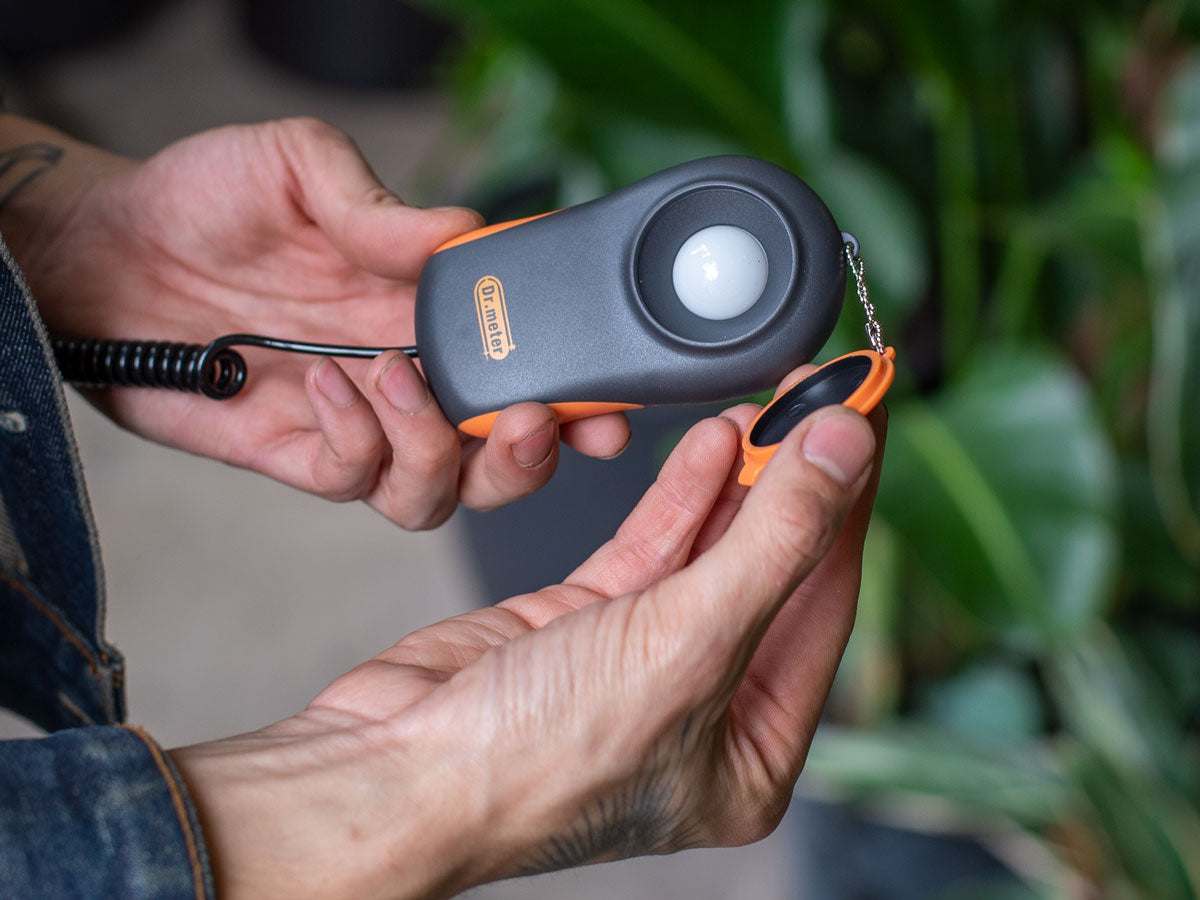
A light meter is a great, reliable way to measure light. We use the Dr. Meter light meter, which has proven to be a reliable tool for the price. We’ll be walking through the steps on how to use this specific device, but it’s a simple process that should translate to all light meters on the market.
Step One:
Remove the cap from the sensor.
Step Two:
Turn on the device. Press the LUX/FC button once. The screen will switch from LUX to FC on the bottom right.
Step Three:
Set your range. Push the RANGE button until you start getting a reading. If your reading is an unmoving "1 . " don’t panic. The RANGE button is simply moving the decimal point forward. You will probably need to press the button a few times to find the right range for your space. The brighter it is, the more times you’ll need to push this button.
Step Four:
The sensor will need to be angled towards the light, NOT TOWARDS YOUR PLANT. We don’t care how much light is bouncing off the leaves, we want to measure the light from the source. The method we use is to hold the light meter as close to the leaves of the plant as possible, with the sensor pointed away from the plant, in the direction of the incoming light. If your plant is against a wall, you can point the sensor against the wall to get an idea of how much light the back side of your plant is getting. This is why plants will often defoliate on the side that’s not facing the window, and why it’s so important to rotate your plants.

Step Five:
Write down the value of your reading and continue to the next section for information on how to use Foot Candles to assess your space.
How to Interpret a Foot Candle Reading
There is no clear consensus on what levels of light individual plants need, and Foot Candle recommendations are all over the map. However, through our sister company Greenery NYC we have the advantage of monitoring plants over the course of years, and have come to rely on the following levels as the bare minimum in which a plant can survive. Many plants classified as “indoor” plants are actually tropical understory plants, which means they have adapted to the filtered light available on the jungle floor, so another note to consider is that too much direct sun can burn plants. However, like humans, plants are adaptable to different lighting conditions, and over time can adjust to a variety of environments. Think about a New Yorker taking a winter exodus to the beaches of Miami: without preventative measures like sunscreen, the sudden shift in environment can be damaging and in extreme cases deadly.

The quickest way to act on a reading is to let the Biotic Plant Light Meter do the matching for you. Once you’ve measured a spot, pick the plant you’re considering and the app tells you whether that spot will actually support it. When it won’t, it suggests plants that would do well there instead, which is usually the more useful answer: the question is rarely “can I keep a fiddle leaf fig here” so much as “what will genuinely thrive in this corner.”
It also works across time rather than just today. Drop a plant onto a spot and the app shows how that position carries it month by month, so you can see which months sustain it and which fall short. A window that comfortably supports a plant in June may not in December, and that difference is the single most common reason a plant that looked healthy all summer starts declining once the days shorten.
If you’d rather work from the numbers yourself, these are the levels we rely on as the bare minimum a plant can survive: plants we classify as low light can survive on 25 FC, and high light plants need at least 150 FC. Remember there’s going to be variation in your readings, depending on the time of day, weather conditions, indoor lighting etc. But as a general rule, you should never place a plant like a fiddle leaf fig tree in an area with 20 FC. There are plants sold as interior plants that require even higher levels of light, such as aralias and podocarpus, but although these are marketed as indoor plants we don't consider them viable for long-term success except in areas with extreme levels of light, such as areas with an abundance of floor to ceiling windows.
The same way humans need to eat organic matter to function, plants need light to photosynthesize. It’s their food. Without adequate lighting for your plant, it will become anemic and eventually die. Second to overwatering, inadequate lighting is the number one killer of plants, so be sure that if you get a plant that loves bright, indirect light, you put it in a place that’s going to nourish it for the long term.